

Healthcare Flooring Solutions
Healthcare flooring must deliver hygiene, low indoor emissions, safety and long-term durability in demanding clinical environments.
Impervia’s GREENGUARD Gold-certified rigid composite stone flooring is rigid-core composite flooring, also FloorScore® certified for indoor air quality. Combined with a moisture-tolerant core, commercial-grade durability, integrated acoustic IXPE backing and low slip potential in independent pendulum testing, it provides architects and interior designers with a flooring solution designed for healthcare refurbishment, care homes and commercial medical environments.
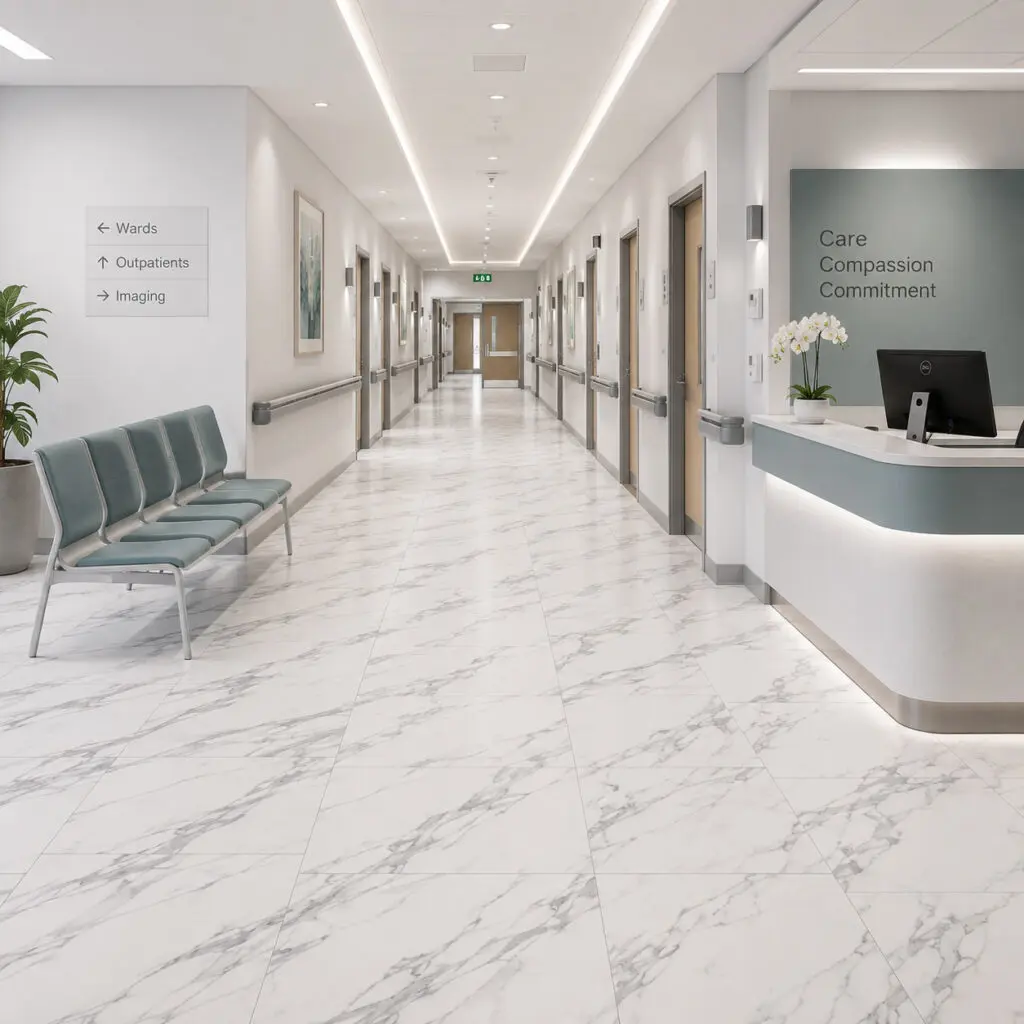
Why Does Flooring Matter in Healthcare Environments?
Healthcare flooring affects infection control, patient and staff safety, acoustic comfort and the long-term maintenance demands of a facility. It should be considered as part of the building’s performance, not simply as a decorative finish. From busy hospital corridors and clinics to care homes and medical practices, flooring must withstand high footfall, wheeled traffic, regular cleaning and everyday spillages while continuing to perform reliably.
Specifying the right flooring early in a project helps reduce maintenance, minimise replacement costs and provide greater long-term specification confidence. Impervia’s rigid-core composite flooring, a commercial LVT alternative, is designed for healthcare refurbishment and fit-out projects, combining a moisture-tolerant core, commercial-grade durability and integrated acoustic backing with GREENGUARD Gold and FloorScore® certifications for low chemical emissions and improved indoor air quality.
Specification priorities for healthcare flooring:
Hygiene
Stain-resistant, easy-to-clean surfaces for routine cleaning regimes.
Safety
Low slip potential in wet and dry pendulum testing, subject to a project slip-risk assessment.
Durability
Built to withstand heavy footfall, wheeled traffic and everyday wear.
Acoustic Performance
Integrated IXPE backing helps reduce impact noise for quieter healthcare
How Can Healthcare Flooring Support Infection Control and Hygiene?
Healthcare flooring should provide a durable, easy-to-clean surface that can withstand frequent cleaning without creating unnecessary maintenance demands. In hospitals, clinics and care environments, flooring is exposed to regular spillages, cleaning chemicals and heavy daily use, making durability and ease of maintenance essential specification considerations.
Impervia features a stain-resistant ceramic lacquer finish that is designed to simplify routine cleaning while maintaining its appearance over time. Its click-fit construction is suitable for many healthcare refurbishment projects, although the floor construction and joint detailing should always be assessed against the hygiene requirements of each clinical zone. Impervia is also FloorScore® certified, demonstrating compliance with strict indoor air quality standards for low VOC emissions.
Healthcare specification consideration: Operating theatres, clean rooms and other specialist clinical environments may require alternative flooring systems with specific installation and hygiene requirements. Impervia is best suited to non-specialist clinical areas, corridors, waiting rooms, patient accommodation and other commercial healthcare spaces.

How Does Low-Emission Flooring Support Healthcare Indoor Air Quality?
GREENGUARD Gold-certified flooring is tested to meet stringent limits for chemical and VOC emissions, helping to support healthier indoor environments in healthcare settings. This makes it an important specification consideration for hospitals, clinics, care homes and other spaces where patients, visitors and staff spend extended periods indoors.
Impervia is GREENGUARD Gold certified, demonstrating compliance with one of the industry’s most rigorous low-emission standards, while FloorScore® certification provides additional independent verification of indoor air quality performance. Impervia’s product data sheets state that it is free from formaldehyde, and the flooring is designed to minimise emissions without compromising durability or performance, giving specifiers greater confidence when selecting flooring for healthcare refurbishment and fit-out projects.
Learn more: View Impervia’s GREENGUARD Gold and FloorScore® certifications or visit the official UL GREENGUARD website for further information about the certification standards.
What Flooring Performs Best in High-Traffic Clinical Settings?
High-traffic healthcare flooring requires a durable wear surface and stable construction capable of withstanding continuous pedestrian use and the demands of busy clinical environments. Corridors, receptions, waiting areas and staff spaces all experience constant footfall, wheeled traffic from beds and equipment, and frequent cleaning, making long-term performance a key specification requirement. Areas with heavy rolling loads, such as regular hospital bed traffic, should be reviewed with our technical team, as a fully bonded floor may be more appropriate.
Impervia is rigid-core composite flooring with a commercial-grade wear layer and a stone-based composite core designed for dimensional stability. This construction is designed for high-traffic commercial use, which can help reduce premature replacement and support lower lifecycle costs for healthcare refurbishment and fit-out projects.
| Healthcare Area | Key Flooring Challenge | Specification Priority |
|---|---|---|
|
Hospital Corridors |
Continuous footfall, wheeled traffic and frequent cleaning |
Commercial-grade durability, slip-risk assessment and suitability for wheeled loads |
|
Reception & Waiting Areas |
Heavy daily use while maintaining a professional appearance |
Durable wear layer, stain resistance and easy maintenance |
|
Patient Accommodation |
Balancing hygiene, comfort and noise reduction |
Easy cleaning, moisture-tolerant core and integrated acoustic backing |
|
Staff & Administrative Areas |
High daily use with regular cleaning requirements |
Low-maintenance, hard-wearing flooring |
How Does Slip Resistance Improve Patient and Staff Safety?
Slip resistance is a critical consideration when specifying healthcare flooring, particularly in corridors, entrances and other areas exposed to moisture or spillages. One recognised way of measuring slip performance is the Pendulum Test Value (PTV), which assesses how much grip a floor provides underfoot. Rather than relying on broad “non-slip” claims, specifiers should review verified wet and dry slip performance to ensure the flooring is appropriate for its intended environment.
Impervia has independently tested slip performance. In independent pendulum testing to BS 7976-2 (slider 96), carried out by SATRA in 2019, the Impervia sample tested recorded wet PTV values of 38–40 and dry values of 64–69. Both are classed as low slip potential under UK Slip Resistance Group guidelines (36 and above). Results apply to the sample tested; slip risk in use also depends on contamination, footwear, cleaning and the wider environment, so every project should carry out its own slip-risk assessment. However, the appropriate flooring should always be selected based on the specific risks within each healthcare zone, taking into account expected footfall, cleaning regimes and exposure to moisture.
Specification guidance: Do not specify flooring on appearance alone. Always assess verified slip performance against the intended healthcare environment.
Learn more about specifying commercial flooring in our Low Slip-Risk Flooring guide, and download the full slip test report from the technical library.
Low Slip-Risk Flooring guideCan Acoustic Flooring Support Patient Wellbeing?
Reducing impact sound can help create quieter healthcare environments, particularly in patient accommodation, corridors and care settings where continuous footfall contributes to background noise. Effective acoustic flooring can improve comfort for patients while creating a more pleasant working environment for healthcare staff.
Impervia features an integrated IXPE acoustic backing. In laboratory testing to BS EN ISO 10140-3 (SRL Technical Services, 2019), a loose-laid 6.5mm Impervia sample on a 160mm concrete reference floor achieved a weighted impact sound reduction (ΔLw) of 21 dB. Performance in a finished building depends on the floor construction and site conditions. The built-in underlay can also simplify the flooring build-up by removing the need for a separate acoustic underlay where the project specification and subfloor conditions allow.
ΔLw 21 dB Impact Sound Reduction: Measured in the laboratory on a 160mm concrete reference floor (BS EN ISO 10140-3), helping to create quieter healthcare environments.
Related reading: Find out more in our Cushioned and Sound Insulated Flooring guide.
Cushioned and Sound Insulated Flooring

Flooring for Care Homes and Elderly Accommodation
Care homes, assisted living and other elderly accommodation combine the demands of a healthcare environment with the feel of a home. Flooring needs to support residents’ safety and wellbeing while standing up to daily cleaning and constant use.
Slip-Risk Assessment
Wet slip resistance is particularly important where residents may be frail or unsteady. Impervia’s tested sample showed low slip potential in wet and dry pendulum testing (wet PTV 38–40, SATRA 2019), but no floor can prevent slips on its own. Each area should be assessed for contamination, footwear, cleaning methods and residents’ needs.
Wet-Condition Considerations
Spills in bedrooms, lounges and dining rooms are part of daily life. Impervia’s stone-based core is not susceptible to moisture in normal use and the surface resists everyday spills, but it is not a sealed wet-room system: en-suite shower areas and other wet rooms may need a specialist floor.
Cleaning and Maintenance
A stain-resistant ceramic lacquer finish suits routine cleaning with pH-neutral products. Joint detailing and cleaning regimes should be agreed for each zone.
Acoustic Comfort and Residential Wellbeing
The integrated acoustic backing helps reduce footfall noise in corridors and between floors, and realistic wood-effect finishes create a warm, domestic look rather than a clinical one.
Installation and Refurbishment
Adhesive-free click-fit installation, with no curing time, can help when refurbishing occupied homes room by room. Individual boards can be replaced if an area is damaged.
Which Flooring Options Are Suitable for Healthcare Projects?
The right healthcare flooring depends on the clinical zone, traffic level, cleaning regime and project performance requirements.
Rigid-Core Composite Flooring
- Suitable for corridors, waiting areas, consultation rooms and administrative spaces, subject to project requirements.
- Stain-resistant surface and moisture-tolerant core.
- Commercial-grade wear surface.
- Integrated IXPE acoustic backing.
- Click-fit installation supports refurbishment and retrofit programmes.
Luxury Stone and Marble-Effect Tiles
- Suitable where a stone-effect finish is required without specifying natural marble.
- Moisture-tolerant stone-based core.
- Commercial-grade surface.
- Relevant to reception, waiting and public-facing healthcare areas.
Porcelain and Vitrified Tiles
- Suitable for selected high-traffic applications.
- Water- and stain-resistant.
- Fired at high temperatures for durability.
- Available in first-grade glazed porcelain specifications.
Where Can Impervia Flooring Be Specified in Healthcare Settings?
Impervia flooring is suitable for a wide range of non-specialist healthcare environments where durability, low maintenance and practical installation are key requirements. While specialist areas such as operating theatres and clean rooms require project-specific flooring systems, Impervia provides an ideal solution for many patient, staff and public-facing spaces.
Specification note: Specialist clinical environments, including operating theatres, clean rooms and other controlled spaces, should always be assessed against their specific performance and regulatory requirements before selecting a flooring system.
Hospital Corridors
High footfall, slip risk and cleaning demands.
Waiting Areas and Receptions
Durability with design-led finishes.
Patient Accommodation
Acoustic comfort and easy maintenance.
Care Homes
Wet slip-risk assessment, easy cleaning and acoustic comfort.
Private Clinics
Professional finishes with commercial-grade durability.
Staff and Administrative Areas
High-traffic performance and retrofit suitability.

Benefits of Impervia for Healthcare:
- GREENGUARD Gold Certified – Low chemical emissions to support healthier indoor environments.
- FloorScore® Certified – Independently verified indoor air quality performance.
- Stain-Resistant & Easy to Maintain – Designed for routine cleaning regimes.
- Commercial-Grade Durability – Suitable for high-traffic healthcare environments.
- Low Slip Potential in Testing – Wet PTV 38–40 in 2019 pendulum testing; assess each area.
- Integrated Acoustic Backing – Helps reduce impact noise in patient and care settings.
How Can Healthcare Flooring Reduce Lifecycle Costs?
Durable healthcare flooring can reduce lifecycle costs by minimising premature replacement, simplifying maintenance and supporting efficient refurbishment programmes. Rather than focusing solely on the initial purchase price, specifiers should consider the long-term cost of maintaining, repairing and replacing flooring throughout the life of the building.
Impervia is designed for demanding commercial environments and supports refurbishment projects through its click-fit installation system and retrofit suitability. Where required, individual boards can also be replaced without removing the entire floor, helping to minimise disruption and downtime in occupied buildings. This provides architects, quantity surveyors and project teams with a flooring solution that delivers long-term value through durability, maintainability and reduced replacement risk.
Discover how durable flooring supports long-term value in our guide, How Cost-Effective, Durable Flooring Helps Commercial Developments Stay on Budget.
Read our post hereWhat Specification Support Is Available for Healthcare Projects?
Impervia supports architects, interior designers, contractors and commercial project teams with the technical information needed to specify flooring with confidence. From product selection through to project delivery, our team can help identify the most suitable flooring solution for your healthcare environment.
Specification support includes:
- Product samples for material and finish evaluation.
- Technical product and construction information from the technical library.
- Slip resistance and acoustic performance guidance.
- GREENGUARD Gold and FloorScore® certification information.
- Product suitability advice based on your project requirements.
- Support for refurbishment and retrofit flooring specifications.
- Specify Healthcare Flooring With Greater Confidence
Whether you’re designing a new healthcare facility or refurbishing an existing one, Impervia can provide the technical guidance, product information and samples needed to support your specification.
Discuss Your Healthcare Project


Specify Healthcare Flooring With Greater Confidence
Every healthcare project has unique performance requirements. Whether you’re specifying flooring for a hospital refurbishment, private clinic, care home or medical practice, Impervia can help you identify the most appropriate flooring system, finishes and technical performance credentials for your project.
Request a sample to assess the product firsthand, or discuss your project with our team to ensure your flooring specification meets the practical, aesthetic and performance demands of your healthcare environment.
Get in touch
INFO
Your Cart 

No items found